
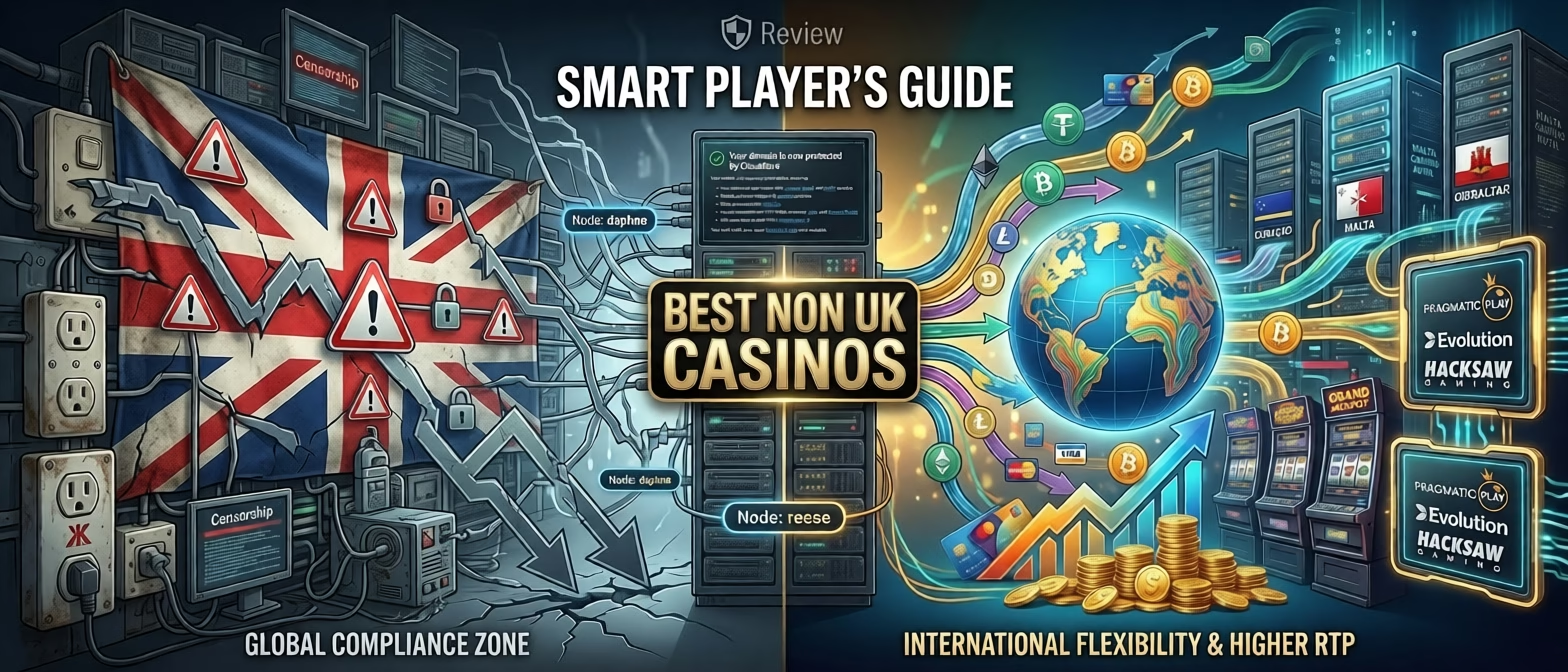
The online gambling landscape across the UK and Europe has undergone a quiet but fundamental restructuring over the past three years. It is not driven by preference or aesthetics — it is driven by mathematics, friction, and the basic economics of consumer value.
Domestic regulatory frameworks, once positioned as player protections, have increasingly functioned as margin compression engines. The result is a measurable degradation in what players actually receive in return for their wagers. Experienced, high-volume players have noticed. The migration data reflects it.
The Economic Divergence: Lower Taxes vs. Higher RTP
At the core of this migration is a straightforward fiscal reality: UK and European licensed operators carry a tax burden that offshore operators simply do not.
The UK Gambling Commission’s point-of-consumption (POC) tax currently sits at 21% of gross gaming revenue. In Germany, newly regulated operators face effective rates that climb higher still. These costs do not vanish — they are transferred directly into the mathematics of the product.
Slots from the same software provider, running on the same code, return materially different figures depending on where the operator is licensed.
- UK-regulated platforms: RTP configurations typically cluster between 91–93%, adjusted to accommodate the tax overhead and licensing fees embedded in the cost base.
- Offshore operators — particularly those licensed in Curaçao or operating under frameworks such as the Curaçao LOK framework — face no equivalent tax on player revenue. This allows them to configure and publish uncapped RTP slots in the 96–98% range, figures that are independently verifiable via software provider audit certificates.
The distinction is not cosmetic. On a £10,000 annual wagering volume, the difference between a 92% and a 96.5% RTP slot is approximately £450 in expected return. At high-stakes volumes, that gap is significant.
Costa Rica-licensed platforms operate under a similarly light fiscal regime. They function less as a regulatory jurisdiction and more as a corporate registration framework, meaning operators carry almost no government-imposed margin drag. The product they can afford to offer reflects that.
Freedom of Capital: Crypto, Credit Cards, and Borderless Banking
Regulatory divergence is not limited to game mathematics. It extends into every layer of how money moves.
The Domestic Banking Problem
Since the UK’s credit card gambling ban in April 2020, players have faced a progressively narrower set of deposit options. What followed was not a clean transition — it was a cascade of friction. Debit card transactions trigger source of funds (SOF) checks at thresholds that feel arbitrary to professional or high-volume players. Bank transfers are flagged. E-wallets face renewed scrutiny under affordability assessment frameworks.
For players depositing £1,000 or more in a session, the administrative overhead of domestic compliance has become a genuine operational constraint. Documentation requests, temporary account suspensions pending review, and hard deposit limits imposed without player consent are now routine experiences on major UK-facing platforms.
The Offshore Alternative
Independent gambling platforms operating internationally have structured their payment infrastructure around a fundamentally different philosophy: capital belongs to the player until it is wagered.
The adoption of crypto payment rails — primarily USDT and BTC — has resolved the banking friction problem in a single step. Transactions settle in minutes. There are no intermediary bank flags, no SOF declarations triggered by deposit size, and no credit card bans to navigate.
Beyond crypto, many international operators have integrated fintech intermediaries — services that process transactions through e-money institutions outside the UK regulatory perimeter — allowing players to use cards or bank transfers without triggering domestic compliance architecture.
The combination of no-KYC processing at entry level and crypto optionality has made international platforms functionally frictionless by comparison. For players who treat gambling as a deliberate leisure allocation rather than a compulsion, the paternalistic friction of domestic compliance frameworks reads as a product defect, not a safety feature.
Navigating the Global iGaming Market Safely
Freedom from domestic restrictions does not mean freedom from due diligence. The international iGaming market contains operators of wildly varying quality, and the absence of a UKGC license means the absence of that particular safety net.
Smart players applying analytical rigor to their platform selection should evaluate the following:
- SSL certification and encryption standards — look for TLS 1.3 and valid certificates from recognized authorities. Any platform handling financial data without this is disqualified immediately.
- Operational history — established operators with a verifiable multi-year track record carry demonstrably lower counterparty risk. A platform that launched six months ago with no public-facing corporate identity is a different proposition entirely.
- Verified software providers — the presence of certified studios such as Evolution Gaming, Pragmatic Play, NetEnt, or Play’n GO is a meaningful signal. These providers conduct their own due diligence before licensing their content, which functions as an indirect quality filter on the operator.
- Published RTP documentation — legitimate international platforms publish game-specific RTP figures and link to independent audit certificates. If a platform cannot or will not provide these, the mathematics are not in your favour by design.
- Dispute resolution mechanisms — look for operators affiliated with third-party dispute bodies such as eCOGRA or similar independent arbitration services, which provide recourse in the absence of a domestic regulatory body.
When looking for the best non UK casinos, smart players priorities operators that utilise verified software providers, publish independently audited RTP figures, and carry an established Curaçao or Malta Gaming Authority licence — because the licence type defines both the legal recourse available and the operational standards the platform is contractually bound to uphold.
Reputation within professional gambling communities remains one of the most reliable signals. Forums, player networks, and aggregator review platforms with verified withdrawal confirmations are worth more than any marketing claim an operator makes about itself.
Comparing the Playfields: Domestic vs. International
The differences between regulated domestic operators and credible international alternatives can be distilled into a direct product comparison.
| Feature | UK-Regulated Operators | International/Offshore Operators |
|---|---|---|
| Average Slot RTP | 91–93% | 95–98% |
| Game Library Size | 500–2,000 titles | 3,000–10,000+ titles |
| Crypto Deposits | Not supported | BTC, ETH, USDT, and more |
| Credit Card Deposits | Banned (2020) | Available via intermediaries |
| Bet Limits | Capped (often £2–£5/spin on slots) | Operator-set, frequently uncapped |
| KYC Requirements | Mandatory, often invasive | Tiered; optional at lower levels |
| Bonus Restrictions | Heavy (wagering caps, T&C limitations) | Fewer restrictions, higher ceilings |
| Stake Limits (Slots) | £2 per spin (UKGC mandatory) | No universal cap |
The table is not an argument for recklessness. It is a product specification comparison. On every axis that a high-volume, informed player prioritises, the international offering is currently superior in measurable terms.
Conclusion: Autonomy, Product Quality, and the Market’s Verdict
The migration from domestic to international iGaming platforms is not a fringe phenomenon driven by people seeking to circumvent responsible gambling measures. It is a rational market response to a product quality gap that has widened considerably as domestic regulation has intensified.
Players who approach gambling analytically — as a form of high-engagement leisure with quantifiable expected values — have done the mathematics. Higher RTP configurations, the return of credit card deposits via alternative rails, crypto settlement speeds, and the removal of arbitrary stake limits are not minor quality-of-life improvements. They are fundamental product differentials.
The regulatory intent behind frameworks like the UKGC’s is not in question. But regulation that succeeds in compressing operator margins while failing to demonstrably reduce gambling harm has a predictable market outcome: it pushes the most informed, highest-value players toward jurisdictions that offer a better product.
Player autonomy and product quality have won the argument. The traffic data, the VPN usage patterns, and the growth trajectories of major offshore operators confirm what the economics always predicted. When the domestic product becomes measurably inferior, the market finds an alternative. It always does.
This article is intended for informational purposes only. Players should independently verify the legal status of international gambling platforms in their jurisdiction before registering or depositing.
Related Posts