


































 284Megaways
 249Jackpot
 27Bell Link
 77Dice
 433Animal
 377Asian
 270Egyptian
 320Horror
 206Christmas
 160Adventure
 154Fishing
 167Gems & Diamonds
 127Dragon
 125Irish
 118Gods & Mythology
 215Magic
 93Joker
 76Wild West
 130Pirate
 78Candy & Sweets
 54Book of
 64Aztec
 48Vegas
 38Buffalo
 24Viking
 38Space








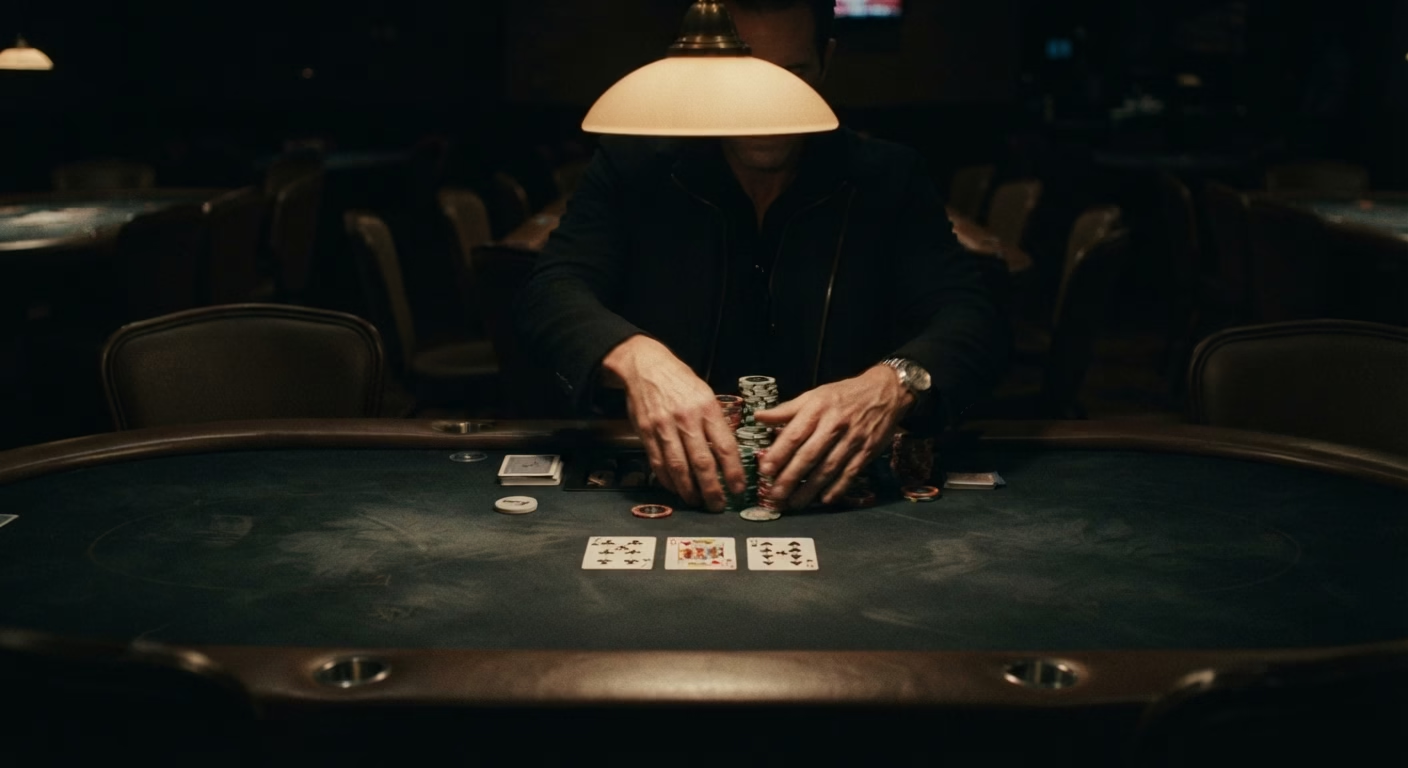
Most poker hands are forgotten before the next one is dealt. A handful are not. The iconic WSOP hands below did something bigger than win a pot: they pushed an amateur past a world-class pro, they turned a throwaway holding into folklore, and in one case they sent a televised card game to a global audience of millions. Here is what actually happened in each, and why it still matters.
Chris Moneymaker vs Sam Farha, 2003 — the bluff that built modern poker
An accountant from Tennessee who had qualified through an online satellite sat heads-up against Sam Farha, one of the most feared cash-game players alive. The flop came 9♠ 2♦ 6♠. Farha held Q♠ 9♥ for top pair. Moneymaker held K♠ 7♥ — king high, and a backdoor flush draw that never arrived.
On the river, with nothing at all, Moneymaker moved all in. Farha, holding the best hand, folded. ESPN commentator Norman Chad called it “the bluff of the century”, and Moneymaker went on to win the Main Event.
The hand worked as television because the audience could see both hole cards and the player could not. For the first time, poker at home looked like a game of nerve you could understand — and, crucially, like a game an ordinary person could enter.
What followed is known in the industry simply as the boom. An amateur with an online seat had beaten the professionals on camera, and entries to the Main Event climbed for years afterwards. No single hand in gambling history has been worth more commercially.
Johnny Chan vs Erik Seidel, 1988 — the WSOP trap that became a film scene
Chan flopped a straight against Seidel’s top pair of queens and did the hardest thing in poker: nothing. He checked. He checked again. Seidel, reading the passivity as weakness, moved all in, and Chan — after the long look at the ceiling that the footage made famous — called instantly.
The published accounts agree on the ranks — Chan holding jack-nine for the straight, Seidel holding queen-seven for top pair on a queen-high board — but they disagree on the suits often enough that we are not going to draw you a hand we cannot verify. What is not in dispute is the shape of it: Chan had the nuts on the flop and got paid in full for pretending otherwise.
It gave Chan his second consecutive Main Event title, making him one of only four players ever to win the event back to back. The clip had a second life a decade later when it was used in the poker film Rounders, which introduced the hand to a generation who had never seen a WSOP broadcast.
Doyle Brunson’s 10-2, 1976 and 1977 — the worst iconic hand in poker
Ten-deuce is, on paper, close to the worst hand you can be dealt. Doyle Brunson won the Main Event with it twice in a row: 10♠ 2♠ in 1976, and 10♦ 2♦ in 1977. Both times it completed a full house on the final hand.
The odds of that are the point. Brunson did not seek out ten-deuce; he was an aggressive player who arrived at showdowns with hands nobody expected, and twice the same improbable holding finished the job. Card rooms still call 10-2 “the Doyle Brunson”, and some run a novelty bonus when it wins a pot.
A hand becomes iconic when the story is better than the cards. Nothing about ten-deuce is strong. Everything about winning the world championship with it twice is unforgettable.
Jack Straus, 1982 — the WSOP hand that needed only a chip
Straus lost a large pot and pushed what he believed was his entire stack into the middle. Standing up to leave, he found a single chip that had been sitting under a napkin. Because he had never verbally declared himself all in, that chip was still live, and so was he.
He rebuilt from one chip and won the 1982 Main Event. The phrase the tournament gave the game — all you need is a chip and a chair — is now said at every level of poker, usually by someone who is about to be eliminated and occasionally by someone who is not.
Jamie Gold, 2006 — the biggest payday in the room
The 2006 Main Event drew 8,773 entries, the largest field the tournament has ever had. Jamie Gold beat Paul Wasicka heads-up for a first prize of $12,000,000 — the largest payout in any poker tournament until the 2012 Big One for One Drop overtook it.
Gold is not remembered for a single brilliant hand so much as for a table presence that talked opponents into decisions. That is a skill too, and it produced the biggest number the WSOP had ever printed on a cheque.
It is also the clearest measure of what the 2003 broadcast did. Three years earlier the Main Event was a specialist tournament with a few hundred entrants. By 2006 it was a field of 8,773 people, most of whom had watched an accountant bluff a professional on cable television and concluded that they could do that too.
Why these hands and not a thousand others
The Main Event has been running since 1970 and deals millions of hands. The ones that survive have something in common that has nothing to do with card strength: a camera, a stake high enough to matter, and a decision the viewer can second-guess from the sofa.
The hole-card camera is the quiet hero of the whole list. Before it, televised poker was unwatchable — you could see bets and faces but never the reason for either. Once the audience knew what each player held, every fold became a story with a villain and a punchline, and a card game turned into a spectator sport.
Nothing on this list would be famous without broadcast. Brunson’s 1976 win was written about; Moneymaker’s 2003 bluff was watched. That difference is worth more to the industry than either pot.
The WSOP names that keep coming up
Any honest list runs longer than five. Stu Ungar won the Main Event three times — 1980, 1981 and 1997 — across a seventeen-year gap that nobody has matched. Brunson and Chan are the two names that recur across eras. And there is a long tail of hands that never made television because the cameras were not there yet.
- 1988, Chan’s second title: only four players have ever won the Main Event in consecutive years.
- 2003, the boom: an online qualifier beating a cash-game legend on camera changed who thought they were allowed to play.
- 2006, the peak field: 8,773 entries produced a $12m first prize that stood as the record for six years.
- 1982, the chip: a rules technicality about declaring all in is the only reason the phrase exists.
What these iconic WSOP hands do and do not teach you
There is a tempting lesson here that is simply false: that bold play wins. Moneymaker’s bluff worked because Farha could fold; Brunson’s ten-deuce worked because the board cooperated twice in two years. These are the surviving stories from tens of thousands of hands, and survivorship is doing most of the work.
The real thread is that every one of them turned on information. Chan trapped because he read passivity correctly. Moneymaker bet because he read a player capable of laying down top pair. Straus stayed in because he knew a rule his opponents had forgotten. None of it was luck alone, and none of it was courage alone.
Poker rewards the player who knows exactly what the rules, the odds and the opponent will allow. Slots do not work that way — the maths is fixed before you sit down — which is why the only information that matters there is the paytable and the return percentage.
If the numbers behind a game are what interest you, that is a habit worth carrying to the rest of the casino floor. Every review in our free slots hub states the published RTP, the volatility and where the figure came from, and where a studio publishes nothing we say so rather than guessing. You can also compare games side by side before you play one for money.
Play responsibly. Gambling is 18+, and no hand in this article was won by a strategy that beats a house edge.
Related Posts