

























 284Megaways
 249Jackpot
 27Bell Link
 77Dice
 424Animal
 368Asian
 268Egyptian
 320Horror
 206Christmas
 156Adventure
 152Fishing
 165Gems & Diamonds
 126Dragon
 124Irish
 118Gods & Mythology
 211Magic
 93Joker
 76Wild West
 128Pirate
 74Candy & Sweets
 53Book of
 62Aztec
 48Vegas
 37Buffalo
 24Viking
 38Space





Blackjack is the only game on a casino floor where the player’s decisions change the house edge, which is why blackjack strategy is a real subject and not a superstition. Everything below comes from published figures rather than folklore, and the first thing those figures say is blunt: most of the money lost at a blackjack table is lost to bad rules and bad decisions, not to bad luck.
Basic blackjack strategy is the whole foundation
Basic strategy is a fixed chart of the mathematically best action for every combination of your hand and the dealer’s up card. Hit, stand, double, split — there is one correct answer for each, and it does not change with mood, streak or the person sitting next to you.
Played with the right rules and perfect basic strategy, the house edge in blackjack typically sits between roughly 0.5% and 2% depending on the table, with a return to player as high as about 99.5% at the good end. That is the best number available anywhere in the building, and it is free — the chart has been public for decades.
A player using basic strategy and a player guessing are playing two different games at the same table. The cards are identical; the expected cost per hour is not close.
The chart is not intuitive, and that is the point. Two decisions in particular feel wrong to almost every player the first time they meet them.
Both are correct, and neither is a matter of taste. The chart is solved output: it does not claim these hands win, only that every alternative loses more over time.
The blackjack rules that cost you before you act
You can play a flawless chart and still be in a bad game, because some of the edge is decided by the felt before a card is dealt. Two rules matter more than all the others combined.
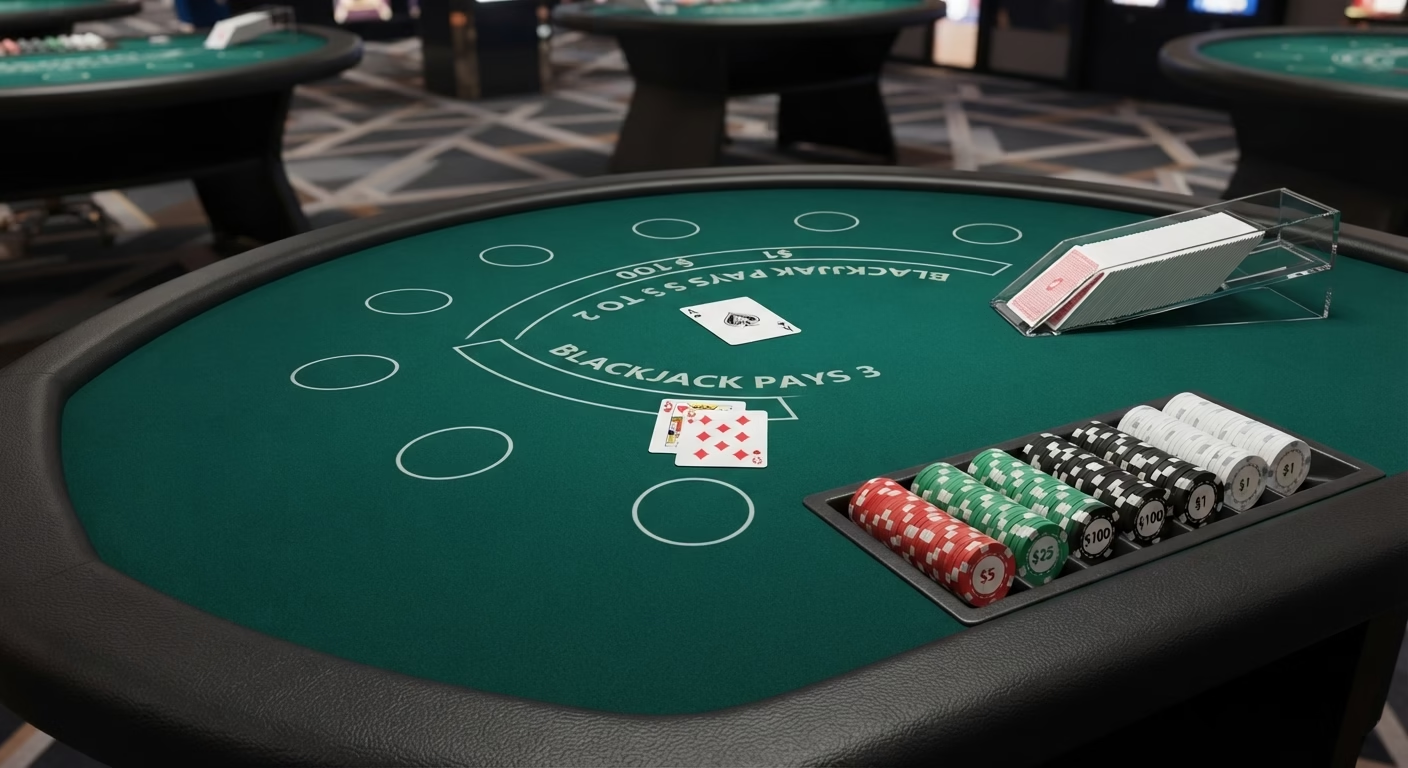
- 6:5 instead of 3:2 on a natural. This single change is commonly measured at about 1.4% of extra house edge — more than the entire edge of a well-ruled 3:2 game. A 6:5 table can undo every good decision you make at it.
- Surrender, where it is offered. Used correctly it reduces the house edge by roughly 0.08%. Small, but it is free and most players never use it.
- Dealer hitting or standing on soft 17, the number of decks, and whether you may double after splitting all move the number as well — always in smaller increments than the 6:5 change.
- Side bets. They are priced as entertainment, not as blackjack, and they are not covered by basic strategy at all.
Check the payout printed on the felt before you sit down. If it says 6 to 5, the best blackjack strategy available at that table is to find another table.
Insurance is the easiest blackjack mistake to stop making
When the dealer shows an ace you are offered insurance at 2:1. It sounds like protection. It is a separate bet on whether the dealer holds a ten, and the dealer completes a blackjack there roughly one time in three — a 2:1 payout on a worse-than-2:1 proposition.
Measured as its own wager, insurance carries a house edge commonly put at over 7%, which is worse than almost anything else on the table. For a player not counting cards, the correct frequency for taking insurance is never.
Insurance is sold as a hedge and priced as a side bet. The name is doing work the maths does not support.
What card counting actually is, and what it is not
In 1962 the mathematician Edward O. Thorp published Beat the Dealer, the first book to prove mathematically that blackjack could be beaten. Working with MIT’s IBM 704, Thorp showed that removing cards from play genuinely shifts the odds, and that with perfect play of the strategies he developed the house edge could be pushed down to around 0.21% — and, when the remaining deck was favourable, past zero to the player.
The mechanism is unglamorous. Counting does not memorise cards; it tracks the running balance of high cards against low ones. A deck rich in tens and aces produces more naturals and more dealer busts, so the counter bets more in those moments and less in the others. The edge lives in the bet sizing, not in any individual hand.
Two things follow that most articles leave out. First, the resulting advantage is small and slow — a fraction of a percent, realised over enormous numbers of hands, which means a large bankroll and real tolerance for losing sessions. Second, the book changed the industry: casinos responded with more decks, earlier shuffles and continuous shuffling machines specifically to blunt it.
What the films got wrong about counting cards
Screen counters work in seconds: a savant glances at a shoe, sees the future, and leaves with a suitcase. The reality is a bookkeeper’s job. The count is a single running number, adjusted by one as each card appears, and the player’s job is to keep it accurate for hours while talking, drinking a soft drink and looking thoroughly ordinary.
The edge that produces is not a jackpot. It is a sliver — under one percent in most descriptions — that only becomes money across tens of thousands of hands. Over a weekend it is invisible; a counter can be perfectly correct and comfortably down. That combination of tiny advantage and large swings is why counting demands a bankroll most recreational players would never dedicate to it.
It is also why the countermeasures work so well. More decks, earlier shuffles and continuous shuffling machines do not need to eliminate the advantage — they only need to shrink it below the point where sitting there for hours is worth anyone’s time.
Counting cards is not illegal, and it is not magic. It is a low-paid job with an unpredictable salary, performed under observation by people who would rather you did something else.
The blackjack habits that separate good players from the rest
- Read the table before you sit. Payout, deck count, soft 17 and whether surrender exists. Thirty seconds here is worth more than any in-play decision.
- Use the chart without exceptions. Deviating on a hunch is how a 0.5% game becomes a 2% game.
- Decline insurance every time, including when you hold a blackjack yourself.
- Set the session size before you start, in hands rather than in money, and stop at the number.
- Never chase the last hand. Blackjack has no memory; doubling your stake after a loss changes your variance, not your edge.
Where blackjack strategy stops working
Everything above applies to a game with a dealer, a shoe and a known rule set. It does not transfer to slots, and anybody selling you a slot “strategy” is selling nothing. On a slot machine the return percentage is fixed in the build the casino installed, and no decision you make at the reels moves it by a hundredth of a point.
That is why the only useful slot habit is the one that mirrors reading the blackjack felt: check the number before you play. Every review in our free slots hub states the published RTP and where it came from, and several studios ship the same game at three or four different return levels — the same kind of hidden rules difference as a 6:5 table. Our how we rate page explains what we check and what we refuse to guess.
Blackjack rewards discipline more than any other game in a casino, and still does not promise a profit. Play responsibly — 18+.
Related Posts