

















 284Megaways
 249Jackpot
 27Bell Link
 77Dice
 433Animal
 377Asian
 270Egyptian
 320Horror
 206Christmas
 160Adventure
 154Fishing
 167Gems & Diamonds
 127Dragon
 125Irish
 118Gods & Mythology
 215Magic
 93Joker
 76Wild West
 130Pirate
 78Candy & Sweets
 54Book of
 64Aztec
 48Vegas
 38Buffalo
 24Viking
 38Space





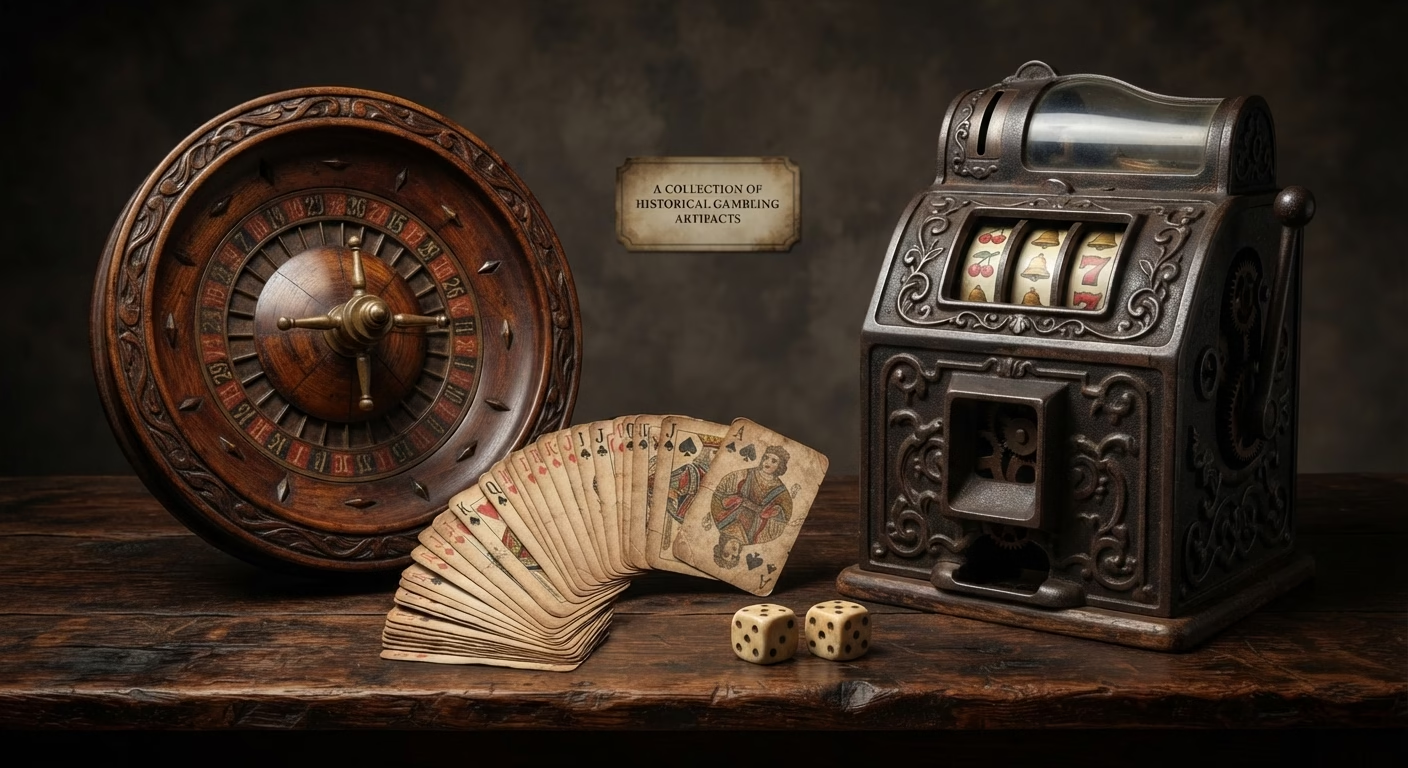
Nothing on a casino floor was designed for a casino floor. The casino game origins behind roulette, blackjack, craps, baccarat and the slot machine run through failed physics experiments, medieval soldiers, French card rooms and a San Francisco workshop — and in most cases the game was already centuries old before anybody thought to put a house edge on it.
Roulette — the origin story that starts with a failed invention
Roulette is credited to Blaise Pascal, the French mathematician and physicist, who developed an early form of the wheel in the seventeenth century while trying to build a perpetual motion machine. He did not succeed at the physics. He did produce a spinning wheel that people immediately found more interesting than the problem it was meant to solve.
The version recognisable today took shape in France in the eighteenth century. The irony is neat enough to be worth stating plainly: a device intended to run forever without losing energy became the most reliable way ever devised of transferring it steadily from one party to another.
Pascal was trying to defeat friction. Instead he built the machine that best demonstrates why a small, constant edge always wins in the end.
Blackjack — from vingt-et-un to the maths
Blackjack appears in French casinos as vingt-et-un, or twenty-one, around 1700. For its first two and a half centuries it was a card game like any other: played on feel, argued about in bars, with no agreed correct way to play a given hand.
What changed it was not a rule but a book. Edward Thorp’s Beat the Dealer, published in 1962, was the first work to prove mathematically that the game could be beaten, and it turned twenty-one into the one casino game with a published optimal strategy. Casinos responded by changing deck counts and shuffling practice — a game reshaped by its own analysis.
Craps — the game that came home from the Crusades
Craps is a shortened American form of the European dice game Hazard, which is documented as far back as the Crusades. It crossed the Atlantic, lost most of Hazard’s complications, and became the fast street-and-casino game that is now the loudest table in any American casino.
One addition mattered more than the rest. In 1907 John H. Winn introduced the Don’t Pass bet, allowing players to bet against the shooter. That is why craps has the social shape it does — a table where most people are cheering the same outcome, and a few deliberately are not.
Baccarat — the aristocratic origin that became the biggest game on earth
Baccarat originated in Italy in the fifteenth century before moving to France, where it was taken up by the nobility. For most of its history it was a game of exclusivity — played privately, for large sums, by a small number of people.
It has never lost that association, and it is the reason the modern game sits in high-limit rooms behind a rope. It is also, by revenue, the dominant table game in the Asian casino markets that now lead the industry — which makes a fifteenth-century Italian card game arguably the most commercially important product in gambling today.
The slot machine — the youngest origin on the floor
The first modern slot machine was built by Charles August Fey, a mechanic working in the United States in the late nineteenth century. His three-reel, single-coin machine — the Bell — set a standard that lasted for decades, and the layout he chose is still the ancestor of every reel-set you see today.
Everything since has been elaboration on Fey’s frame. Electromechanical machines, then video reels, then random number generators, then the online games that no longer have reels at all and merely draw pictures of them. The fruit symbols that still decorate classic fruit slots are the direct descendants of that first mechanical cabinet.
Roulette is four hundred years old and baccarat is older. The slot machine, which now produces most of the revenue on a Western casino floor, is the newest idea in the room by a century.
Poker and keno — the origins nobody agrees on
Two games on this floor have histories that are genuinely contested rather than merely old. Poker’s ancestry is claimed by several traditions at once — a Persian card game, a French betting game, a German bluffing game — and historians still argue about which one the American version actually descends from. The honest position is that it is a convergence rather than a single invention.
Keno has the opposite problem: a very famous origin story that is difficult to verify. It is routinely said to have funded the Great Wall of China, a claim repeated so often that it is now part of the game’s marketing. What is not in doubt is that a numbers-draw game of this shape is ancient, and that it arrived in the United States with Chinese immigrants in the nineteenth century before being renamed for a local audience.
Where a game’s origin is disputed, the version you hear most often is usually the one that made the best advertising copy.
What the casino game origins have in common
- None of them were invented to make money for a house. The edge was applied later, to games people already enjoyed.
- Most travelled before they were formalised, picking up rules in each country — which is why regional variants still differ.
- The simplifications stuck. Craps beat Hazard and twenty-one beat its rivals because they were quicker to learn.
- Only one was designed as a machine, and that one now out-earns all the others in most Western casinos.
There is a pattern in the survivors. A game that lasts four centuries is fast to explain, slow to master and decisive within a minute. Every game on this list can be taught to a newcomer in under two minutes, and none of them makes you wait long to find out whether you were right.
Where the oldest ideas turn up in modern slots
Modern slot studios raid this history constantly. Egyptian symbolism, card-rank royals inherited from vingt-et-un decks, the bells and fruits from Fey’s cabinet, and wheel bonuses that are simply roulette with a different label — all of it is on the reels of games released this year.
If you want to see how far the borrowing goes, the Egyptian slots collection and the classic slots section are the two clearest places to look, and every game in our free slots hub can be played free before any money is involved.
Four hundred years of iteration has not changed the underlying arrangement: the house sets the price, and the player decides whether it is worth paying. Play responsibly — 18+.
Related Posts