





















 284Megaways
 249Jackpot
 27Bell Link
 77Dice
 433Animal
 377Asian
 270Egyptian
 320Horror
 206Christmas
 160Adventure
 154Fishing
 167Gems & Diamonds
 127Dragon
 125Irish
 118Gods & Mythology
 215Magic
 93Joker
 76Wild West
 130Pirate
 78Candy & Sweets
 54Book of
 64Aztec
 48Vegas
 38Buffalo
 24Viking
 38Space





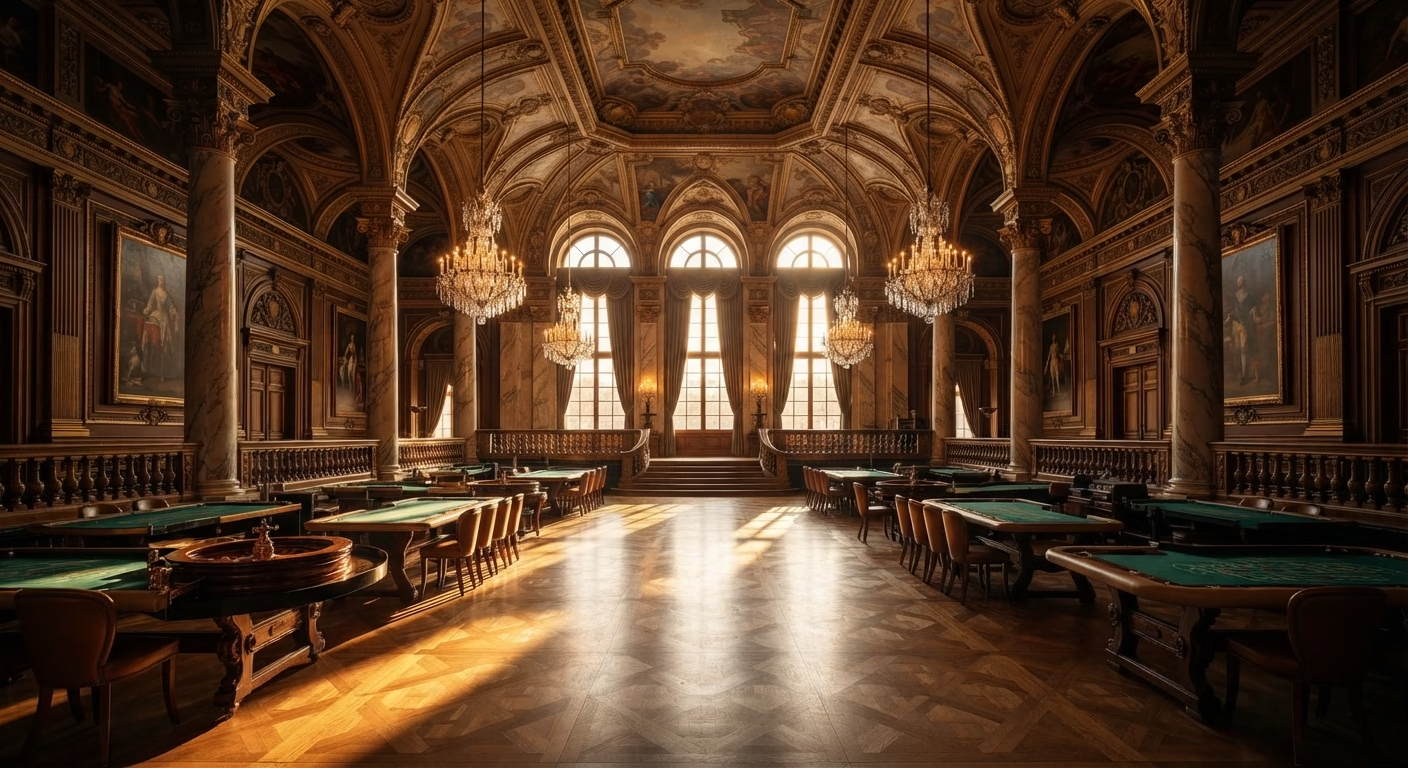
Every casino you have ever walked into is a copy of something. The influential casinos in this article are the originals: the rooms that invented state-licensed gambling, the resort, the theme, and the idea that the gambling is only part of what you are buying. Four centuries separate the first from the most recent, and you can trace a straight line through all of them.
The Ridotto, Venice, 1638 — the first of the influential casinos
The Ridotto was established in Venice in 1638 by the Great Council of Venice and is generally recognised as the first known European gambling house. What makes it the beginning of the story is not that people gambled there — people had gambled everywhere for millennia — but that a government sanctioned it by decree in order to control it.
That is the invention. Licensed premises, official oversight, and gambling treated as something the state permits and supervises rather than something it merely tolerates or bans. Every regulator that now issues an operating licence is working from the template written in Venice.
The Ridotto’s real legacy is not the card tables. It is the licence — the idea that gambling happens in a named building, under rules somebody signed.
Monte Carlo, 1863 — gambling becomes glamour
The Monte Carlo Casino dates to the 1860s, and its contribution was image. Its opulent architecture and long association with European aristocracy turned gambling from a vice conducted in back rooms into a destination that respectable people travelled to on purpose.
It also proved that a very small state could finance itself on gambling tourism, which is a lesson that has been copied by jurisdictions on every continent since. When a modern resort sells you marble, dress codes and a sense of occasion, it is selling Monte Carlo.
The Flamingo, Las Vegas, 1946 — the casino as a resort
The Flamingo opened in 1946 under the mobster Bugsy Siegel, and it set the tone for the modern casino by bundling the gambling with everything around it — lavish design, entertainment, and an atmosphere that treated a night on the floor as a night out.
Before the Flamingo, a gambling hall was a room with games in it. After the Flamingo, the game was one attraction inside a property built to keep you on site. Every integrated resort since, in Nevada and everywhere else, is running that model.
Caesars Palace, 1966 — when influential casinos learned to theme
Caesars Palace took the resort idea and added a fiction to live inside: a Roman world with staff, statuary and architecture committed to the bit. Its Circus Maximus, later rebuilt as The Colosseum, turned the casino showroom into a venue serious enough to host long-running residencies by major performers.
That is the second half of the modern business model. The theme gives a property an identity that a competitor cannot simply undercut on table limits, and the entertainment gives it a reason to be visited by people who have no intention of gambling at all.
The Mirage, 1989 — the megaresort era
The Mirage is the property most often credited with starting the Las Vegas megaresort boom: a scale of capital investment that only made sense if the resort itself, rather than the casino floor alone, was the draw. What followed on the Strip through the 1990s — larger, more expensive and more spectacular each time — is a direct response to it.
It is also the property where one of gambling’s better stories starts: in 1989 a retired Second World War veteran named Elmer Sherwin won $4.6 million on a Megabucks machine there. Sixteen years later, aged 92, he hit the same progressive again for $21.1 million at the Cannery. He had said winning it twice was his lifelong ambition.
Macau and Singapore — where the influential casinos are now
The last two decades moved the centre of gravity east. Macau took the integrated-resort model developed on the Strip, applied it to a market with vastly more customers within a short flight, and became the largest casino economy in the world. Singapore then licensed the format deliberately and tightly, as an instrument of tourism policy.
The interesting part is what got copied and what did not. The resort, the theme and the entertainment all travelled. The Las Vegas emphasis on slot machines did not travel nearly as well — the Asian floors are dominated by baccarat, and the mix on any given floor still reflects local taste far more than any global standard.
- 1638, Venice: the licence, and the idea of supervised gambling.
- 1863, Monte Carlo: glamour, tourism, and a state funded by play.
- 1946, the Flamingo: the resort — gambling bundled with everything else.
- 1966, Caesars Palace: the theme, and the casino as a live-entertainment venue.
- 1989, the Mirage: megaresort scale, and the arms race that followed.
- 2000s, Macau and Singapore: the model exported, and rebalanced around table games.
The buildings that nearly made the list
Any six-name list is an argument, and there are properties with a strong claim to have been just as influential. The Bellagio made the luxury end of the Strip respectable to a wider audience and gave poker its most famous room. The Venetian exported the Las Vegas format to Macau under its own name, which is arguably the single most consequential move of the last twenty years.
Outside the two obvious capitals there are older rooms still trading on being first in their own countries, and a long list of riverboat and tribal properties in the United States whose real influence was legal rather than architectural — they proved a jurisdiction could licence gambling on its own terms without becoming Nevada.
The most influential casinos are rarely the biggest ones. They are the first ones to try something everybody else then copied for fifty years.
What the influential casinos built that you use online
Almost every convention of an online casino is inherited from a building. The loyalty tier is the comped high roller. The welcome bonus is the free room. The lobby organised by studio and theme is the floor plan, and the live dealer stream is quite literally a table from Caesars with a camera on it.
What did not survive the move online is the part that hid the maths. In a building you cannot see a return percentage anywhere; online you often can, and where a studio publishes one we print it. Every game in our free slots hub is playable free with the figures we could verify attached, and our casino bonuses page compares the offers that replaced the comped suite.
Four hundred years on, the licence invented in Venice is still the only thing standing between a player and an unaccountable operator. Play at licensed sites, and play responsibly — 18+.
Related Posts